

Special Interest Group: Creative Research Methods
The SIG Creative Research Methods (CRM) is an informal network where creative researchers can share experiences and ideas across disciplines. The SIG CRM aims to promote good practices for creative research practice and creative research education. It also aims to increase knowledge about creative research methods and discuss ways to further develop them. Growing communities of researchers demonstrate a
Performance Research Journal “On Spirituality”
This special journal issue, edited by Theron Schmidt and Evelyn Wan, invites the study of spirituality via a performance studies lens, considering the ways in which attention to spiritual practice can foreground alternative lineages of knowledge transmission, subaltern histories and marginalized figures, and non-standard views on media, technology, ecology, and embodiment.
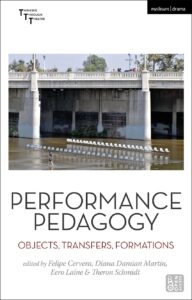
Performance Pedagogy
Performance Pedagogy: Objects, Transfers, Formations (edited by Felipe Cervera, Diana Damian Martin, Eero Laine, and Theron Schmidt, with contributions from UU MCW researchers Anika Marschall and Maaike Bleeker) is an Open Access publication that explores an expanded approach to pedagogy via performance, in which to teach and learn performance is to teach and learn how to do
Dramaturgy as a Practice of Lateral Movement
This project involves Sigrid Merx, Anastasia Hacopian and Trine Friis Sørensen, who together are developing a learning activity and a research article on Co-created Positionality Statements. The purpose of the project is to enable students working in a group tobecome aware of and reflect on their own positionality and that of others. This will enable them
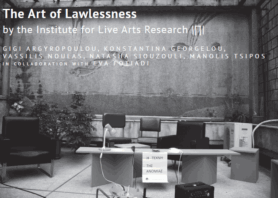
The Art of Lawlessness
The Art of Lawlessness is an interdisciplinary practice-based research project about artistic, activist and political practices that operate at the borders of the law. Konstantina Georgelou (UU) was one of the co-initiators, as part of the collective Live Art Institute (Greece). The project took place in Athens, Amsterdam and Berlin and consisted of talks with political philosophers, artists, psychiatrists, activists, lawyers and
Holistic Method, Holistic Technologies
The Holistic Technology Salon (V2_Lab for the Unstable Media, Rotterdam) is a gathering space for collective reflection, embodied exploration, and alternative ways of relating to technology. Evelyn Wan has been a member since 2024. Through conversation, sensory practices, and shared experiences, the project invites participants to imagine futures beyond extraction, acceleration, and digital alienation, for instance, through an emphasis on eco-centric and
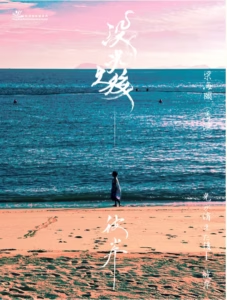
Beyond the Shore
The research and performance project Beyond the Shore is led by artist Alysa Leung (Alumnus of MA CTDD ‘22, UU) at artist collective If Time’s Limited (Hong Kong): Evelyn Wan is a dramaturg and occasional performer. Beyond the Shore focuses on Inter-Asian maritime histories and feminist mythologies, and is presented through the mediums of live performance, dance, film, wearable art, table-top
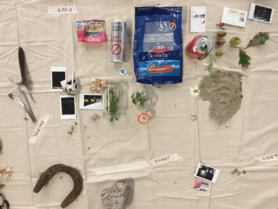
Creative Urban Methods Dossier
This special issue of Mediapolis, A Journal of Cities and Culture by Sigrid Merx, Coco Kanters, Michiel de Lange, and Nanna Verhoeff, introduces a dossier that positions creative methods as vital approaches for researching contemporary urban life. The authors argue that experimental, situated, embodied, and relational practices—such as data walking, performative mapping, experimental ethnography, and participatory research—generate forms
The Art of Being a University
The Art of Being a University is a creative, arts-based dialogue method that uses the tapestry Being a University as a catalyst for collective inquiry into the role, values, and societal meaning of the university. Rather than seeking consensus or solutions, participants engage in open-ended conversations that explore multiple perspectives through close observation, reflection, and discussion of the artwork. By
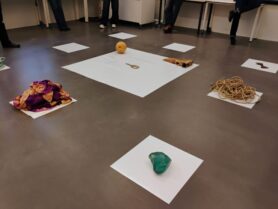
Het Vlak /The Square
Het Vlak is a creative, object-based dialogue method that enables participants to collaboratively explore complex societal and research-related questions. Rather than debating or seeking solutions, participants use physical objects to represent actors, relationships, and emotions, generating shared reflection through embodied, spatial interaction. Guided by Sigrid Merx, the process encourages active listening, perspective-taking, and engagement with ambiguity and discomfort. By treating