
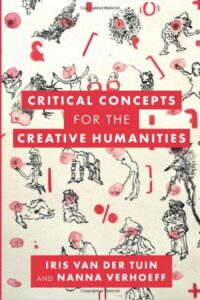
Book review: Critical Concepts for the Creative Humanities by Iris van der Tuin and Nanna Verhoeff
Jonathan Jaschinski Critical Concepts for the Creative Humanities is a dictionary that compiles 70 concepts bearing the potential to unfold critical power and open up new lines of thought in what the authors call the “creative humanities”. They use this phrase to underline that both humanities and the “field of design, art, and
“Performing Robots Conference: Dialogues Between Theater and Robotics”
The Performing Robots Conference took stock of interactions between theatre and robotics so far and looked at possibilities for future collaboration. Over the course of three days, there were more than 25 presentations and demonstrations, which included keynote addresses by Peter Eckersall (CUNY), Maarten Lamers & Peter van der Putten (Leiden University), Petra Gemeinboeck (UNSW)

“Questions struggling to be asked” – Ieva Pranckūnaitė
On the 16th of May, 2019, the first two volumes of the new book series Thinking Through Theatre were launched: Thinking Through Theatre and Performance, edited by Joe Kelleher (Roehampton University, London), Adrian Kear (University of the Arts, London), Heike Roms (University of Exeter, UK) and Maaike Bleeker (Utrecht University) and Nomadic Theatre: Mobilizing Theory
“Walking Through an Uncanny Valley” – Jose Hopkins B
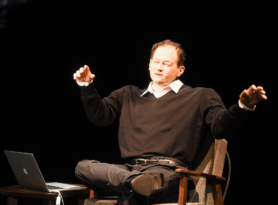
The Uncanny Valley is a concept coined by Masahiro Mori and borrowed by theatre director Stephan Kaegi[i] to make a homonymic performance. This concept is used to explain the dip in human’s affinity and affective pairing in relation to a replica’s human likeness. The valley’s dip is produced when an apparently human-like replica, for example
“(Human) being: striving for perfection” – Gido Broers
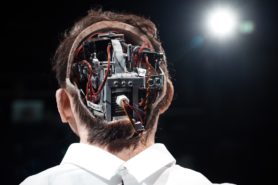
While attending and participating in the Performing Robots Conference I have been thinking a lot about the relation between humans and robots and the different kind of questions that emerge out of this relation. In most of the panels, lectures, and performances this relation – or interaction – was used as a starting point for
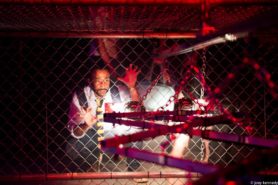
“Unproductive and Misbehaving Machines: Exploration of Atypical Robots Through Art” – Irene Alcubilla Troughton
As Stelarc (2014) rightfully puts in a talk called “Error, function and behaviour”, the term “misbehaving”, as opposed to “malfunctioning”, requires certain intentionality and agency. “Misbehaving”, he proposes, can only happen in the presence of someone, whereas “malfunctioning” could take place in the absence of a person, as it relates to an error in the
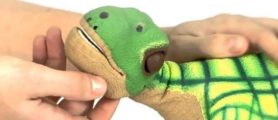
“Touchy Robots: Developments in Social Robotics and Robotic Art” – Irene Alcubilla Troughton
The fact that senses are organised under a hierarchy through which some of them are given more importance is not something new. Throughout history, vision, for example, has held a privilege position, followed by sound, and leaving the rest of senses far behind. In the last years, the humanities have explored what kind of paths
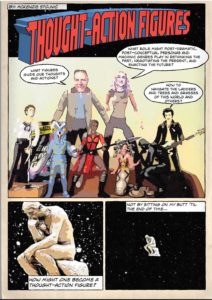
“Performance Lecture: Thought-Action Figures” – Jon McKenzie & Aneta Stojnic
This lecture performance focuses on performance, technology, and post-ideational thought, the reinscription of ideas with a broader spacetime suggested by Artaud, Derrida, Haraway, Lehmann, and others. What figures guide our thoughts and actions? What role might post-dramatic, post-conceptual personae and machinic genres play in rethinking the past, negotiating the present, and enacting the future? How
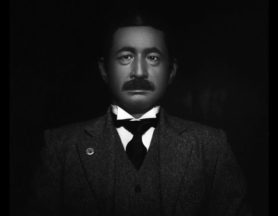
“Robotics, Reenactment and Collective Memory” – Nadine Westveer De Mul
I had a very rewarding, enjoyable and inspiring time interning for TiM’s Performing Robots project managed by Professor Maaike Bleeker. As a Research Assistant, I was assigned the primary task of organizing and collecting additional research for the project’s ongoing research archive. Where I divided research and included my own findings into sub-themes and topics,

“Expert Meeting on Robotic development”- Nadine Grinberg & Swantje Schaeuble
Imagine: A woman brings her boyfriend to work every day. They take the metro together. She takes care he doesn’t fall but somehow he also appears independent. He makes a rigid but friendly impression. In fact, he would seem over-alert if it wasn’t for that slight, endearing smile. ’He’ is made from plastic and his