

Iris van der Tuin appointed professor in Theory of Cultural Inquiry
We are very happy to share with you that our own TiM Community Member Iris van der Tuin, has been appointed Professor of Theory of Cultural Inquiry at the Faculty of Humanities! The chair is part of the Department of Philosophy and Religious Studies and is part of the Research Institute for Cultural Inquiry (ICON)
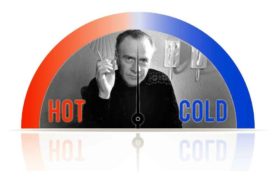
“Revisiting McLuhan’s temperature of media” – Max Peters
There is hardly any figure more prominently present in the academic discipline of media studies than Marshall McLuhan. His theories have shaped and cemented the study of media, and he stands out at as a creative mind who coined, created and analyzed terms and concepts for media. However, this does not mean that his theories are

Sebastian Kann
Sebastian is a circus artist, theorist, pedagogue, and performance dramaturg. He received his diploma in circus practice from ENC (Montréal) in 2009 and his MA in Theatre Studies from Utrecht University in 2016, graduating with a thesis which examined technical virtuosity in performance. As a dramaturg, he works in dance and circus contexts, collaborating with
Danae Kleida
Danae is a research master student of Media, Art & Performance Studies at Utrecht University. She holds a BA in Communication, Media, and Culture from Panteion University (Athens, GR) and a BFA in Classical Ballet and Contemporary Dance from Kontaxaki Professional Ballet School (Athens, GR). Her BA thesis is titled: “Theatre of light: The shift

“Research as Embodied Practice: Emotion and the dancing self” – Sebastian Kann
In mainstream culture, emotions almost always seem to be connected to an object, image, or speech act – that is, to an ‘other’ – which makes the subject feel a certain way. So, for example, ‘it makes me feel sad to see images of suffering’, or ‘it makes me feel happy that my friends threw
“Understanding prehistoric art” – Alexandra Kinevskaya
It is still debated by many scholars in art history whether or not should Prehistoric art, such as cave drawings, be studied as an art form at all or just considered a historical and archaeological phenomenon. This is due to the fact, that there are no other sources or documents from that era that could

“Exploring issues of embodiment in VR through the scope of Cave Art” – Elissavet Kardami
Nicolas Salazar’s seminar on cave art, created a strange feeling of anachronism. In a period characterized by a “digital turn”, and in a period the where the “virtual” poses new ontological questions about issues of embodiment and human experience, how can cave art offer new insights on art, experience and culture? The easy answer would
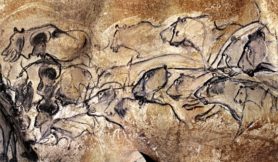
“Two Animals One Line” – Tamalone van den Eijnden
As part of the Transmission in Motion Seminar 2017/2018 Nicholas Salazar Sutil gave a lecture on “How to get a Wall to Dance.” His speech was based on the objects of limestone, caves and cave paintings. However, while speaking of these objects of the Palaeolithic age, often also referred to as ‘prehistory,’[1] he was simultaneously
“Dancing the Cave” – Gido Broers
Before discussing the movement in cave art, I will address briefly movement in another art form, namely dance: “In watching a collective dance – say, artistically successful ballet – one does not see people running around; one sees the dance driving this way, drawn that way, gathering here, spreading there – fleeing, resting, rising, and
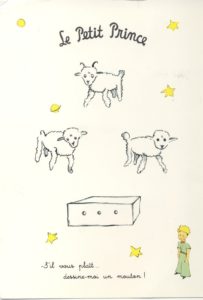
“Imagination transmission through Exupérism: what’s in the box?” – Max Peters
Nicolas Salazar Sutil’s engaging lecture gave fascinating insights into prehistoric artworks, through an analytical approach reminiscent of an archaeologist or even geologist. Through his discussion of caves, limestones, sedimentary rocks and the impact of darkness on artists, he showed us how the principles of artistic practices can be recognized and interpreted in centuries-old rock paintings. The key