
“Function of Exploration” – Aishwarya Kumar
In his 2012 TedEd talk, marine biologist David Gallo illustrates the idea of exploration by stating that we, as humans have ‘explored’ only 5% of what is in the oceans. By exploration, he means to “go peek and see what’s there” and uncover, reveal, bring to the front, what was invisible or unknown[1] and that,

Transmission in Motion Seminar (2019-2020): “Expanded Practices of Knowing: Interdisciplinary Approaches”
Technological developments inform the ways information travels through media, turn archives into ‘dynarchives,’ and set knowledge cultures in motion. Such developments foreground the performativity of practices of sharing knowledge and the materiality of mediation; moreover, they point to the sensory, movement and embodiment as important aspects to take into account. This year’s seminar will investigate

“Questions struggling to be asked” – Ieva Pranckūnaitė
On the 16th of May, 2019, the first two volumes of the new book series Thinking Through Theatre were launched: Thinking Through Theatre and Performance, edited by Joe Kelleher (Roehampton University, London), Adrian Kear (University of the Arts, London), Heike Roms (University of Exeter, UK) and Maaike Bleeker (Utrecht University) and Nomadic Theatre: Mobilizing Theory
“Sewing, sewing, sewing” – Jose Hopkins B.
In her book Travelling Concepts in the Humanities: A Rough Guide, Mieke Bal (2002) presents us with a particular way to understand the performance of concepts and its relation with subjects and objects. She argues that concepts are not fixed as they travel between disciplines, individual scholars, geographically dispersed academic communities and so on. Therefore,
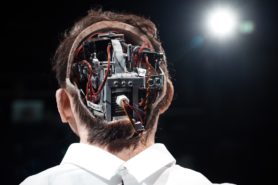
“(Human) being: striving for perfection” – Gido Broers
While attending and participating in the Performing Robots Conference I have been thinking a lot about the relation between humans and robots and the different kind of questions that emerge out of this relation. In most of the panels, lectures, and performances this relation – or interaction – was used as a starting point for

Call For Volunteers
At the Performing Robots Conference, in collaboration with SPRING Performing Arts Festival, we are looking for enthusiastic volunteers to join our team! It will be a great opportunity for you to meet people with similar interests, as well as artists and scholars of the field, and for you to enjoy a creative environment. Volunteers are

“How can we ever describe the agency and experience of human beings?” – Gido Broers
Arun Saldanha’s lecture, which was called Stratification of cyberspace: from experience to waste, was for me a step outside of my academic comfort zone. In my own research, I focus mainly on theatre and spectatorship which I am exploring through a cognitive neuroscientific lens. This does not mean that Saldanha did not address interesting and
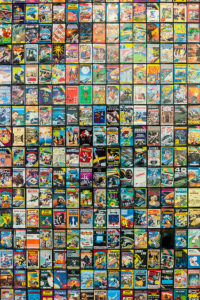
“Personal Experience and the Ignorance of Ecological Matters in Videogame Studies” – Dennis Jansen
When speaking about digital media and cyberspace, we—scholars, critics, users—still tend to forget that even the most ephemeral-seeming media have a material past, present, and future. While this kind of alienation is a problem of all consumption under global capitalism, awareness of the specific histories of digital commodities like videogames strikes me as only a
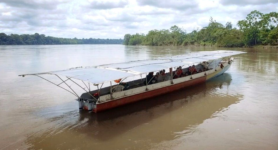
“Solar Canoes to Navigate the Technosphere” – Laura Jimenez Rojas
What is the connection between technology, environment, and race? Are the utopic promises of an inclusive space in the ‘technosphere’[1] impossible to reach? Is it time to question how the stratification of cyberspace leads to an uneven distribution of global scale? Arun Saldanha reflected upon some aspects of these questions. The title of his presentation
Astronomy/Cosmology as fields for performance theory
Building on the perspectives of the previous points, we can also consider the extent to which performance may not only be an enactment or procedure, but a natural quality of the universe. That is, performance as an ontology of the Universe. Here, we draw initial impetus from Karen Barad’s work. In Meeting the Universe Halfway,